
What does Average vs. Median Home Price Mean?

At my office the other day, we were talking about whether a person should look at the median or the average when it comes to home prices and getting a clearer understanding of the market. I remembered back when I had to educate myself about what those two different terms meant. I had learned their definitions in college, but I had forgotten their meanings from disuse. Here is what I learned as I refreshed my memory. 

What is an “average” home price?

Finding the average price of a home in an area goes like this. Say you have 101 houses, all at different prices. You put the prices in a spreadsheet, and add the total of all of the prices together, then divide it by 101. That gives you an average price over the whole spread of homes. 

What is a “median” home price? 

On the other hand, if you want a median price, let’s take those same 101 houses and line them up from the least expensive to the most expensive. The median is the price of house number 51 in the lineup—the very middle house. 

For an even simpler way to view this, look at the image below.
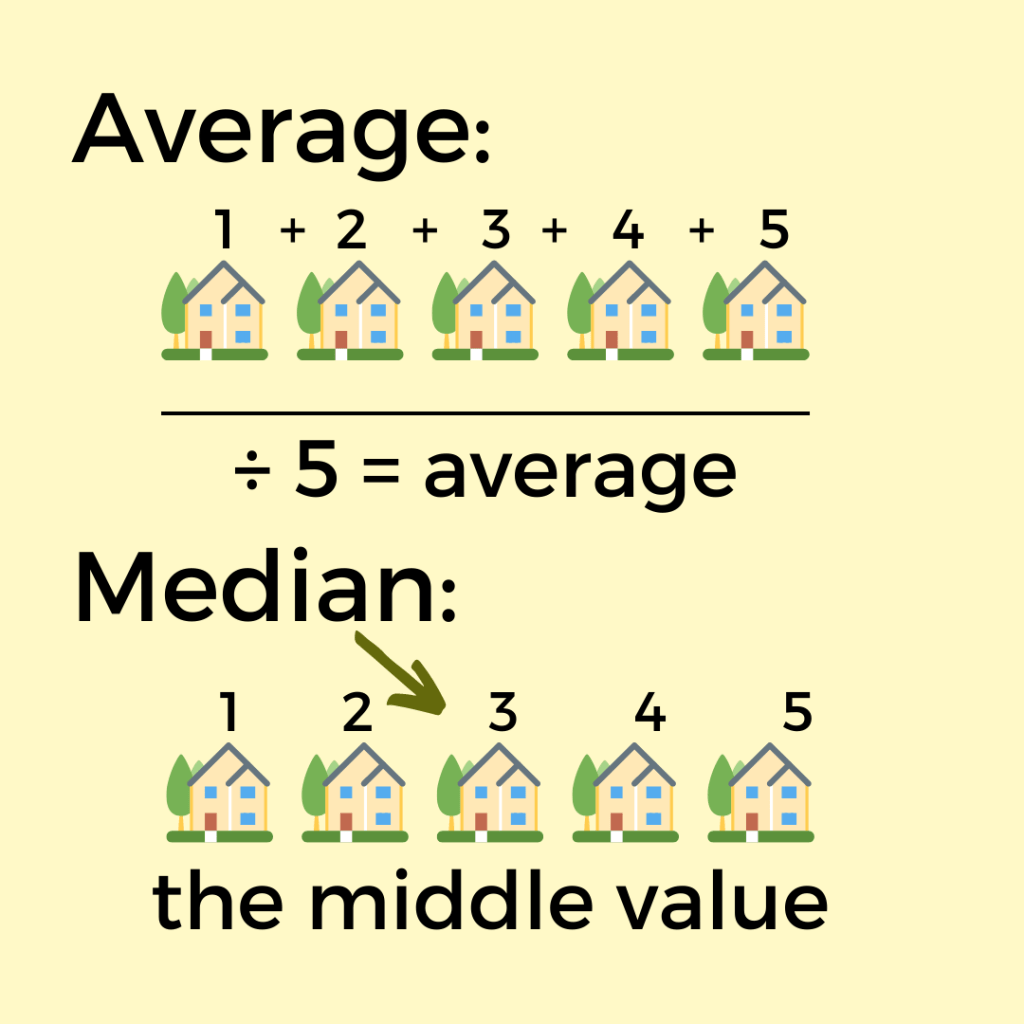
In this image, you can see that if you add 1+2+3+4+5 = 15, and then if you divide it by five (the number of houses you are comparing) you get three. For the median, you just line them up, and the middle one is three. This image is definitely an oversimplification, but hopefully it helps see what each statistical method is doing.

When I look at statistics on housing, I prefer to use the median, and here is why. If there are a 101 people buying a home, I am curious about what is in the middle of that situation. There are equal numbers of homes on both sides of that middle. One thing about the average is that if there are a large number of luxury homes in a market (as with Washington County, Utah) those home prices can pull up the average by virtue of the higher values of the more expensive homes. If we get a big enough number of those expensive properties, we see averages that look much higher than many homes are actually priced. 

Occasionally it’s good to watch the average, too, though. For example, in a shifting market we can watch trends. If the average gets closer to the median, that could be a sign of shifting prices from higher to the middle or lower. So which one should you look at first? For me, I usually look at the median. Really, it’s up to you, and hopefully these median v. average notes have helped a little as you decide which to use.

Affordable Housing Lender Perspectives with Emily Magill

https://www.podbean.com/media/share/pb-tqvjc-1322d06

With over twenty years in the lending business, Emily Magill gets really excited when it comes to attainable housing. In this episode we talk about her experience, what the market is doing right now, and how it compares with the last comparable market cycle. 
Emily Magill

April Gates and the Impact of Vacation Rentals on Affordable Housing in Washington County Utah

https://www.podbean.com/media/share/pb-v7q5w-12f2d3e

April Gates works at ERA Brokers Consolidated, and she has served the Hurricane Valley and Springdale side of Washington County for quite some time. In our interview we talk about a few aspects of attainable housing, including city policies that could help as well as the impact of vacation rentals on our market. 

You can catch her on the web at her Facebook page with The April Gates Group

April Gates and Jenny Chamberlain
Jenny and April at the ERA Office

Innovative housing solutions with student Heather Johnson and Professor Bill McMurrin

Heather Johnson studied architectural drafting at Dixie Tech, and as part of her studies she came up with a creative idea to help with bringing more affordable housing options to market. In this episode, she and her professor, Dr. William McMurrin, share about her project and ideas. 

Listen to the episode here:

Innovative Housing Solutions

Something New is Coming!

The microphone and me.

Something new is coming to this website. I would describe myself as beyond excited, but that would be too short. I am excited, but I am also nervous, thrilled, and if there were another word for nervous that involved introverts stressing about having to talk to people they respect, admire, and don’t know very well about a subject near and dear to their hearts—well that would be the other thing beyond excited.I often have this conversation.

Well-meaning loved one (WMLO): “What have you been up to?”

Me: “I’m going to graduate school.”

WMLO: “What are you studying, and where are you going to school?”

Me: “Technical Writing & Digital Rhetoric at Utah Tech University.”

WMLO: (confused look)

Me: “It’s a kind of Masters degree in English.”

“What will you do with it?”

Me: “I don’t really know.”

Part of my reason for going to graduate school, aside from it being a dream, was because I was having second thoughts about doing real estate. I’m an introvert. Can introverts succeed as realtors? That is a great question for another time. As I have gone through my program I figured out that I do in fact care deeply about the housing market. It affects every person, and in our county in particular housing is a huge issue. People who have lived here for generations are wanting so much to hold on to our agricultural heritage, but we also want our children to be able to live here. What can we do? Well, remember the “Digital Rhetoric” part of my degree title? It turns out that Podcasting is a form of Digital Rhetoric. So for part of my major project portfolio, I will be launching a podcast here on this blog very soon. I can’t wait to share it with you. I have interviewed some amazing people already, and I’m just putting the finishing touches the first few episodes. So hold tight, and soon you will be able to listen to the Jenny Chamberlain Podcast, and this first season we are going to focus in on Attainable Housing in Washington County.